
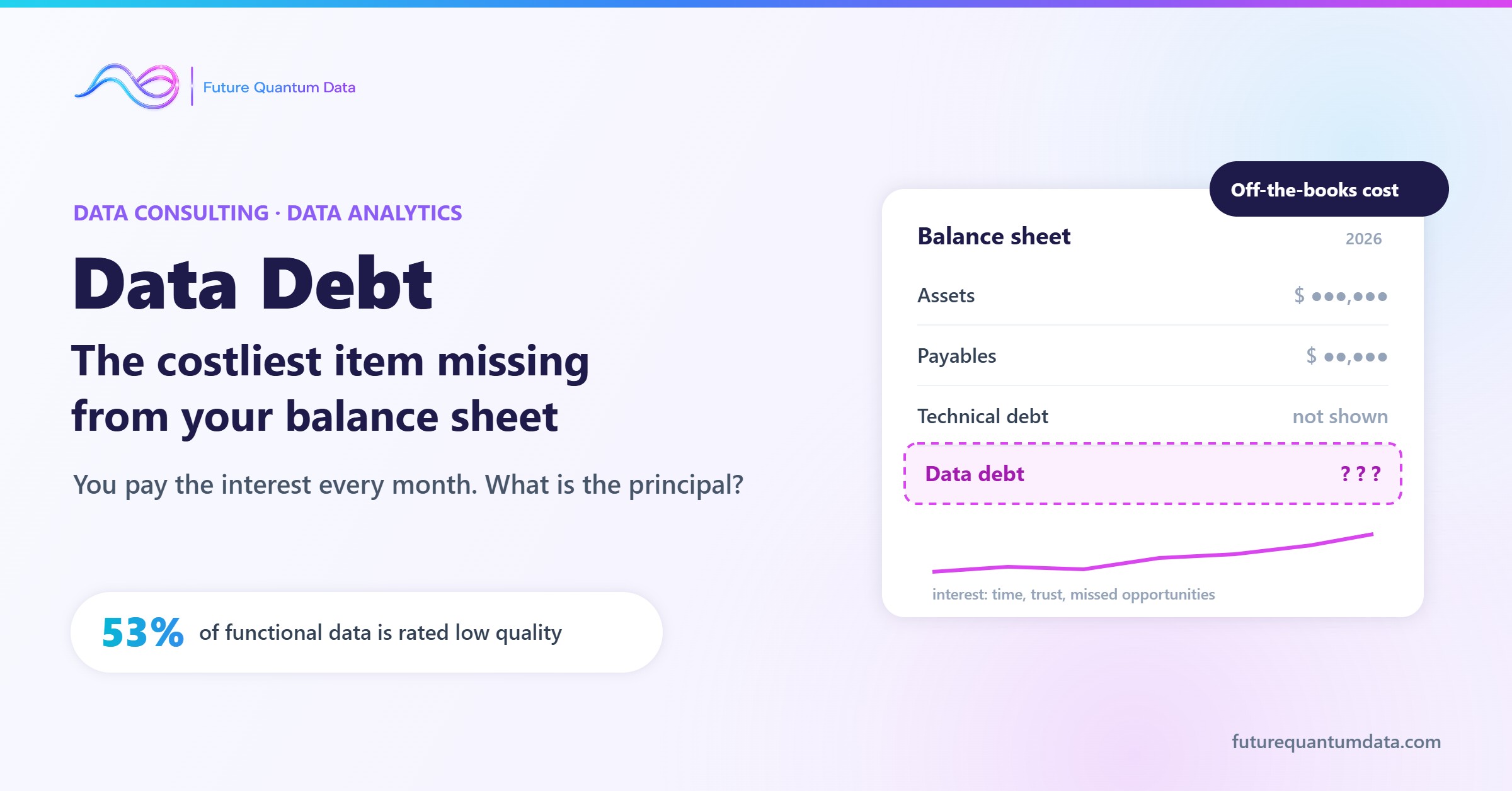
Your balance sheet lists payables, loans and tax liabilities line by line. But there is one debt that never appears there, and almost every company pays interest on it every month: data debt.
Three different revenue figures on the table at the month-end meeting. An analyst spending half the week fixing reports. Nobody able to answer “where did this number come from?” within a minute. These are all instalments on the same debt.
What is data debt?
Software developers know the idea of “technical debt”: quick fixes made today to ship faster come back later with interest. Data debt builds up the same way. It is the gap between the data a company has and the data its decisions and new projects actually need.
A copy of an Excel file, a metric nobody ever defined in writing, a table with no owner, a manual correction made every month. None of these is a disaster on its own. But over the years they pile up, and every new report and every new AI initiative ends up carrying that weight.
What do the numbers say?
Research published by Genpact and HFS Research in June 2026, based on a survey of more than 2,000 executives across 16 industries, measured four kinds of “enterprise debt”: data, process, technology and talent. The data picture is striking:
- 53% of the data used by business functions is rated low quality.
- Only 33% of enterprise data is ready to be used in AI projects.
- 42% of analytics and AI initiatives are delayed, underperform or fail because of data quality issues.
- More than half of companies have no funded initiative to pay down these debts, and only 6% qualify as proven “debt resolvers”.
The study estimates the value locked up by these four debts across the world’s 2,000 largest companies at roughly 18 trillion dollars, about 7.7 trillion of which is attributed to data debt alone. Scaled down to your own business, the question becomes: what is this line item worth in your company?
How data debt builds up: 5 familiar paths
1. The “my own Excel” culture
Every department has its own file, its own formulas, its own update day. The same sales data lives in five places, and each copy drifts further from the others over time. We covered this in detail in Decisions Lost in Excel.
2. Metrics with no written definition
To finance, “revenue” means invoiced amounts excluding VAT. To sales, it is the order total before returns. To a store manager, it is what went through the till. Until the definition is written down, everyone is right and no two numbers match.
3. Data with no owner
If a product’s category is wrong, who fixes it? If a customer is recorded three times with three addresses, which one is correct? Data without an owner degrades on its own, and fixing it always stays “someone else’s job”.
4. Dirty master data
The same product can exist in the system as “Sunflower Oil 5 Lt”, “SUNFLOWER OIL 5L” and “Sunflower oil 5 lt.”. In retail, these small differences ripple through stock, pricing and competitor comparison reports. In our competitor price monitoring system, product matching was the most time-consuming part of the work.
5. Manual steps that depend on one person
“Only one person can prepare this report” is not an efficiency problem; it is a risk indicator. Every undocumented manual step turns into debt the moment that person goes on leave or moves on.
How you pay the interest
The interest on data debt does not arrive as an invoice. It is paid in time, trust and missed opportunities:
- Meeting time: arguing about whether a number is right instead of making a decision.
- Analyst time: cleaning the same data every month instead of doing new analysis.
- Trust: once a report turns out wrong, the team stops trusting it. Most dashboards that nobody opens die this way.
- AI: projects that start with data that is not ready get stuck in pilot. More on that in why AI projects get stuck in pilot.
The 5-minute data debt test
Give yourself 1 point for every “yes”:
- The same metric (revenue, margin, stock) comes out differently in different reports.
- An important report can only be prepared by one person.
- Some reports still come from Excel files that are merged by hand every month.
- There is no written glossary of metric definitions.
- You know there are duplicate or incorrect records in your master data (products, customers, suppliers), but nobody is clearly responsible for fixing them.
- When a number is challenged, you cannot show its source within a minute.
0–1 points: your debt is manageable. 2–3 points: interest is starting to build up, and you will feel it in new projects. 4 or more: it will be cheaper to pay down the debt before starting a new report or AI project.
Paying down the debt: 5 steps
- Take inventory. Which decisions rely on which reports, and which reports pull from which sources? See the map first.
- Write a metric glossary. Agree on a single, written definition for 10–15 core metrics such as revenue, margin and active customer, and get management sign-off.
- Build a single data layer. A data warehouse or lakehouse that reads from source systems without touching them is the technical form of a “single source of truth”. We compared the options in Data Warehouse or Lakehouse?.
- Assign owners. Give every master data area (product, customer, price) a business owner. The technical team owns the infrastructure; the business unit owns accuracy.
- Pay the most expensive interest first. Do not try to fix everything at once. Start with the report that causes the most arguments or needs the most manual work, automate the manual steps and move quality checks into the data layer.
Conclusion: debt you can see is debt you can manage
Data debt does not come from bad intentions; it is a natural by-product of growing fast. The problem is not that the debt exists, but that it is invisible. Once it is listed, prioritised and owned, the monthly interest goes down, and the same data becomes reusable in every new report and every new project.
At Future Quantum Data, we take inventory of your data debt through data consulting, connect your scattered sources into a single source of truth with data analytics, and build Power BI reports where everyone looks at the same number. We work without changing your existing systems.
If you scored 2 or more on the data debt test, contact us through our contact page or at [email protected] for a free initial consultation.
Subscribe to our newsletter to stay up to date with content like this.