
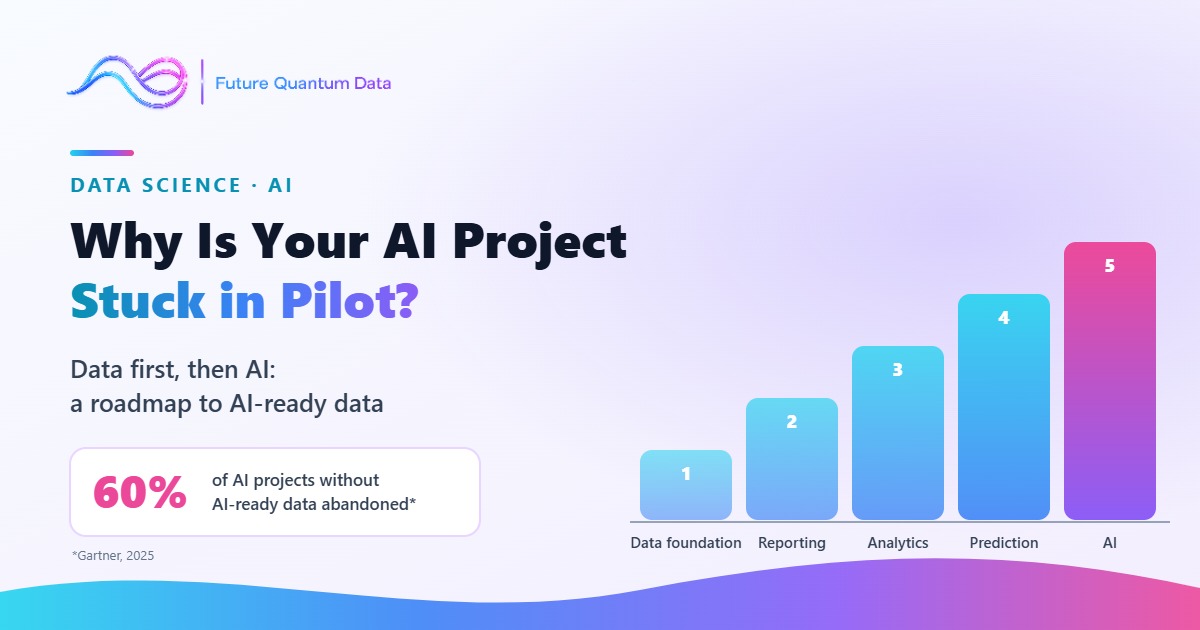
Most AI projects stall in the pilot phase not because the model falls short, but because the data isn’t ready. According to Gartner, 60% of AI projects unsupported by AI-ready data will be abandoned through 2026. In this article, we explain where your business should start to stay out of that 60%.
Everyone wants AI, few get results
Over the last two years, nearly every management meeting has asked the same question: “How do we use AI?” A chatbot was tested, a forecasting model was built, an impressive demo was shown. Then the project was quietly shelved.
The numbers confirm this picture:
- 60%: Gartner predicts that 60% of AI projects unsupported by AI-ready data will be abandoned through 2026.
- 63%: In the same research, 63% of organizations said they either don’t have, or are unsure whether they have, the right data management practices for AI.
- 43%: In an Informatica survey of 600 data leaders, data quality and readiness was the most frequently cited obstacle to moving AI into production.
So the problem is rarely “picking the wrong AI tool.” The problem is that the data feeding the tool is scattered, incomplete and unreliable.
The real problem isn’t the model, it’s the data
An AI model is only as good as the data it’s fed. A sales forecasting model that counts returned sales as real sales will produce wrong forecasts. An assistant answering customer questions from an outdated price list will give customers wrong information.
“AI-ready data” means three things together:
- Fit for the use case: The data must truly represent the problem the model will solve, including campaign periods, faulty records and outliers.
- Understandable: What each field means, where it comes from and when it was updated must be known. This is called metadata.
- Governed: Who can access which data, how personal data is protected and what the data is used for must be defined.
Gartner stresses that this is an ongoing practice, not a one-time project. Data changes every day, and readiness has to be maintained every day.
Is your data ready? 6 questions to ask yourself
Answer these questions honestly before allocating an AI budget. If you answer “no” to three or more, investing in your data foundation first will pay off better.
- Is there a single truth for key figures? Do different departments report the same number for revenue, profit or stock?
- Does data flow automatically? Are reports built by manual copy-paste or by scheduled refreshes?
- Is historical data sufficient and clean? Do you have at least 2–3 years of consistently coded transaction data?
- Are definitions written down? Do terms like “active customer” or “net sales” have a definition everyone agrees on?
- Are data owners clear? Is someone responsible for the accuracy of each data source?
- Is personal data identified? Do you know which tables contain personal data and who can access them?
None of these questions are about AI. Yet all of them determine whether an AI project will succeed.
The right order: from reporting to AI
Successful businesses don’t jump straight to AI; they climb the steps in order. Each step lays the foundation for the next.
| Stage | Question it answers | Typical output |
|---|---|---|
| 1. Data foundation | Where is our data, and how reliable is it? | Central data model, shared definitions, automated data flow |
| 2. Reporting | What happened? | Power BI dashboards, daily KPI tracking |
| 3. Analytics | Why did it happen? | Segmentation, basket and profitability analysis |
| 4. Prediction | What will happen? | Demand forecasting, customer churn risk models |
| 5. AI | What should we do, and can we automate it? | Assistants that talk to your own data, automated recommendations |
The good news: investment in stages 1 and 2 pays for itself. Reporting time shrinks and decisions speed up. And when you reach the AI stage, your data is already ready, so projects move from pilot to production much faster.
Realistic first steps: where to start?
The best candidate for a first AI project is a task where the data already exists, the result can be measured and mistakes can be corrected. Standout areas for SMEs and retailers:
- Demand and order forecasting: Using past sales, seasonality and campaign data to recommend how much of each product to order. Overstock and stockouts fall at the same time.
- An assistant that talks to your data: Letting managers ask questions like “which 10 products dropped the most last month?” directly of the Power BI model. The prerequisite for a correct answer is a solid data model.
- Price and competitor monitoring: Regularly collecting competitor prices, tracking your price position by product and raising alerts on deviations.
- Anomaly detection: Automatically flagging unexpected spikes in returns, cash discrepancies or stock movements.
- Document and invoice processing: Reading supplier invoices and delivery notes and transferring them into your systems automatically.
They all have one thing in common: their success depends on the quality of the data behind them.
Data protection and governance: the overlooked risk
AI tools often send your data to an external service for processing. Your obligations under data protection laws such as Turkey’s KVKK or the EU’s GDPR don’t disappear when that happens. Customer names, phone numbers or purchase histories can easily end up somewhere they shouldn’t in a poorly designed pilot.
Before starting an AI project, the answers to these questions should be clear:
- What data will go to the model, and does it contain personal data?
- Can personal data be masked, anonymized or left out entirely?
- In which country, and by which service provider, will the data be processed?
- Who will review the model’s outputs, and who is accountable when a result is wrong?
Data governance may sound bureaucratic. But well-designed governance doesn’t slow an AI project down; it reduces legal and reputational risk and makes it possible to move into production.
Conclusion: data first, then AI
The AI race won’t be won by whoever buys the fastest tool, but by whoever prepares their data best. Businesses that build their data foundation today will speed up reporting now and, tomorrow, take AI from pilot to production instead of leaving it behind.
At Future Quantum Data, we plan this journey end to end: we assess where you stand with data consulting, build a solid data foundation with data analytics and Power BI, and prepare your data for forecasting and AI projects with data science solutions.
To assess together how AI-ready your data is, reach us at [email protected].
Subscribe to our newsletter to stay up to date with content like this.